
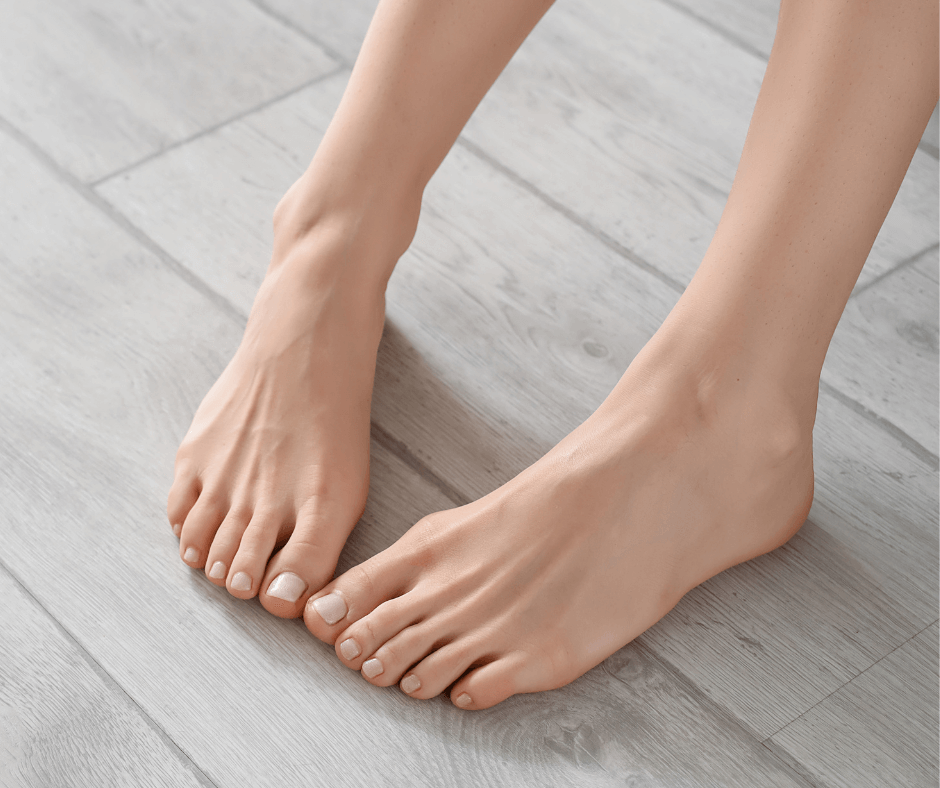
“Why Do I Have Flat Feet?”
The Link Between Genetics, Hypermobility, and ‘Floppy’ Ligaments
“I’ve always had flat feet.”
We hear this often in our office. Patients frequently mention it with a shrug, assuming it’s just a random anatomical quirk, like having blue eyes or curly hair. But in a functional podiatry approach, a flat foot is rarely just a flat foot. It’s a clue.
If your arch collapses completely when you stand, it’s often a sign of a systemic issue with your connective tissue. Specifically, it points to hypermobility, a condition where your ligaments are looser and more “floppy” than they should be.
In this blog, Advanced Foot Care of NJ explains why your genetics might be sabotaging your arch, and why “just wearing a supportive shoe” isn’t fixing the problem.
The Collagen Connection: It’s Not Weakness, It’s Laxity
Many patients are told their flat feet are due to “weak ankles.” They try strengthening exercises, but the arch still collapses.
That’s because the problem isn’t usually muscle weakness; it’s ligament laxity. Your ligaments are the rubber bands that hold your bones together.

In people with hypermobility (or conditions like Ehlers-Danlos Syndrome), a genetic mutation affects the collagen in those ligaments, making them too stretchy.
When you stand up, gravity pushes down.
If your ligaments are too loose to resist that force, the bones of your foot splay out, and the arch hits the floor. You aren’t weak; you’re structurally unstable!
Why Hypermobility Hurts
Being “double-jointed” might seem like a cool party trick, but in the feet, it’s a recipe for chronic pain.
When your arch collapses due to laxity:
- The Joints Jam: Your ankle rolls in, forcing the joints of the midfoot to grind against each other (a precursor to arthritis).
- The Muscles Overwork: Your posterior tibial tendon (the muscle holding up the arch) has to work overtime to do the job the ligaments should be doing. This leads to chronic tendonitis.
- The Chain Reaction: Theinternal rotation of the leg pulls on the knee and hip,often causing pain far away from the foot.
The Functional Solution: 3D Printed Stability
Because this is a genetic structural issue, you cannot simply “exercise” your way into a high arch. You need mechanical stability to do the work your ligaments can’t.
This is why we often recommend 3D printed custom orthotics.
- Unlike generic, squishy insoles that just cushion the blow, a 3D-printed orthotic is a precision medical device.
- We scan your foot in a specific, corrected position (neutral) and print a lattice-work device that is rigid enough to stop the collapse but flexible enough to allow natural movement.
- We are essentially building an external ligament for you!
Don’t Just “Live With It”
If you have flat feet, “floppy” joints, or a history of being “double-jointed,” you don’t have to accept a future of foot and knee pain. By understanding the genetic root of your flat feet, we can treat them effectively. Schedule a consultation with us to stabilize your foundation!
At Advanced Foot Care of NJ, LLC, our doctor and staff proudly serve the communities of Little Falls, Cedar Grove, Verona, Stoney Road, Sandy Hill, Albion Place, and Great Notch. Contact us today to schedule an appointment!


